 This is a rather limited help page for the site. The site is not really
designed for those new to castle studies. See the links page
for sites with introductory essays, glossaries and other such helpful resources.
This is a rather limited help page for the site. The site is not really
designed for those new to castle studies. See the links page
for sites with introductory essays, glossaries and other such helpful resources.
If you are looking to find the castle described as a military stronghold, surrounded by trebuchets and besieging armoured knights and protected by vats of boiling oil, or as a fantasy palace with damsels in wimples, hidden passages and swinging candelabrum or other such 'Hollywood' portrayals this is not the site for you. The complex story of the actual medieval castles of England and Wales is far more rewarding than these 'dramatic' stories but is also rather more challenging.
Gatehouse's author, Philip Davis, has written an essay Defining 'the Castle' but this is not an introduction to castles but a discussion of how castles studies is redefining the castle as a complex social institution rather than a form of building. It is hoped this will inspire thought but it does require a reasonable knowledge base to be properly appreciated.
Descriptions
The description statement on individual site pages is not intended to be a complete or full description of a sites historical, archaeological and/or architectural account.The description is intended to give a general idea of a site so that someone may see if a site is likely to be relevant for their research needs. The description is always derived for one or more published account, such as a scheduled monument report, a listed building description, an archaeological database or an academic text. These descriptions are never the result of fieldwork by the compiler of Gatehouse. These description should be attributed and the source will be given on the page, either in the bibliography or through one of the given online links, along with other references.
Comments
The comments on these descriptions made for some sites are those of Philip Davis unless otherwise stated. I am generally identified as 'Gatehouse' in these comments partly because the database is used in other sites and partly to avoid confusion with others given my common name.Dates
Generally Gatehouse has usually used the abbreviation C11 for eleventh century etc, this was to save bit space from the early days of this website when such concerns mattered. Occasionally some dates are given as c. 1100, meaning about or around 1100. For century the C is always in upper case and for circa the c. is in lower case. Gatehouse generally avoids using AD or CE and all dates, unless otherwise specified, are common era dates.
However, much of the site consists of material from a large variety of sources and numerous other abbreviations forms are used by those sources and generally these are kept in their original form. So you will see 11C; C11th and so on with the use of upper and lower case letters much less consistent. In general the context makes the meaning clear but some caution in interpretation may be need in some cases.
As the information in this site is collected from a variety of sources the use of the term 'medieval' is not consistent. For some authors this term refers to the period from the withdrawal of Roman forces until about 1500, for others this period is two (or more) distinct periods with the 'medieval' period starting about the time of the Norman Conquest. This leads to problem where the description "early medieval" is used as for some this means C5-C10 whilst for others it means C11-C12. Care should be taken in such circumstances. In practice the sites in this website cover a period from the Norman Conquest of 1066 to the end of the reign of Elizabeth I in 1603, with some slight spread beyond these dates.
Bibliographical References
Bibliographical references are in a Harvard format. The form is author surname, forename*,
date, 'article or chapter title' book title or journal name (place of publication:
publisher) Vol. # p. #. The abbreviation Vol. for volume. The abbreviation p. is used for page and
pages; pp. for pages is generally not used as this is felt unnecessary – 'ff' for following is not used; instead the form p. #- (a number followed by a short dash) is used. Part is
abbreviated as pt. – However, generally references to part volumes will be in the form Vol. 2.3 for volume 2 part 3.
References given in the description section derived from authoritative ssources are generally retained in their original format (sometimes with a slight modification required by online formatting).
*Forenames are usually given as just initials. Titles (i.e. Rev., Sir, Mrs etc.) are generally not given.
Some abbreviations and terms commonly used in Gatehouse
| Term | Explanation |
|---|---|
| AP | Aerial Photograph |
| Cadw | a Welsh word which means 'to keep'. Cadw is the Welsh Assembly Government's historic environment division. (Frequently expressed in upper case - CADW) |
| Civil War | There were a number of civil wars in England and Wales during the middle ages but where the term 'Civil War' occurs without date or other description and with capital letters this refers to the English Civil Wars of 1642-1651. |
| CPAT | Clwyd-Powys Archaeological Trust |
| CORS | Continuously Occupied Rural Settlement. Compare with DMV and SMV. A medieval rural settlement that hasn't been deserted. I'm not sure if this new (in 2016) jargon term includes previously rural settlement that are now part of massive urban settlements such as the numerous suburbs of London. Its use has probably not yet settled down. |
| DAT | Dyfed Archaeological Trust |
| DMV | Deserted Medieval Village |
| EH | English Heritage. In records dating from before 1st April 2015 this was the governmental body responsibility for the built heritage in England. After that date English Heritage is the charity responsible for the care of the National Collection of historic monuments with the statutory responsibilities (including the protection of scheduled monuments and listed buildings) being the responsibility of Historic England. | GGAT | Glamorgan-Gwent Archaeological Trust | GAT | Gwynedd Archaeological Trust |
| HBMCE | Historic Buildings and Monuments Commission for England (was) the official name of English Heritage set up under the National Heritage Act 1983. |
| HE | Historic England. The current short form name for HMBCE with statutory responsibility to advise on the historic environment and heritage assets. |
| HKW | History of the Kings Works |
| Leland | John Leland Henry VIII's antiquary. Generally quotes of Leland come from the Lucy Toulmin Smith editions of his Itinerary. |
| NT | National Trust |
| RCAHMS | Royal Commission on the Ancient and Historical Monuments of Scotland |
| RCAHMW | Royal Commission on the Ancient and Historical Monuments of Wales |
| RCHME | Royal Commission on the Historical Monuments of England - The RCHME was merged with English Heritage in April 1999 |
| SMV | Shrunken Medieval Village |
| 'U' | As in 'U' mound. Archaeological shorthand for unknown or unclassified. |
| VCH | Victoria County History - Founded in 1899 and originally dedicated to Queen Victoria, the VCH is an encyclopaedic record of England's places and people from earliest times to the present day. |
Notes on the term 'fortification'The term fortification, in regard to medieval buildings, is one open to much discussion. Many of the buildings in this gazetteer, despite much insistence, were never intended to be used in actual warfare but were meant as a symbolic display of the status of the buildings owner. This does not always mean their defensive features, like machicolations, were sham, although some were. Even when a castle is recorded as being besieged this does not mean it was built to resist a siege; as strongly built houses of high status they were likely to be used as retreats during warfare. In the 17th century English Civil Wars many high status domestic houses, with no military features, were besieged, sometimes for weeks. Care must be taking in drawing conclusions as to the function and purpose of complex buildings like castles. A portico of Corinthian columns does not mean Birmingham Town Hall was built as a temple. A parapet of battlements does not mean a house was built as a military base.Walls, moats and strong gates kept thieves out but there has always been a differentiation between such passive defensive features and the supposed active fortification features which allowed the inhabitants of a 'castle' to fight back against an attacking army. In this website fortification means a particular type of architectural style derived from military considerations - some of these military consideration were actual, some potential and some symbolic. |
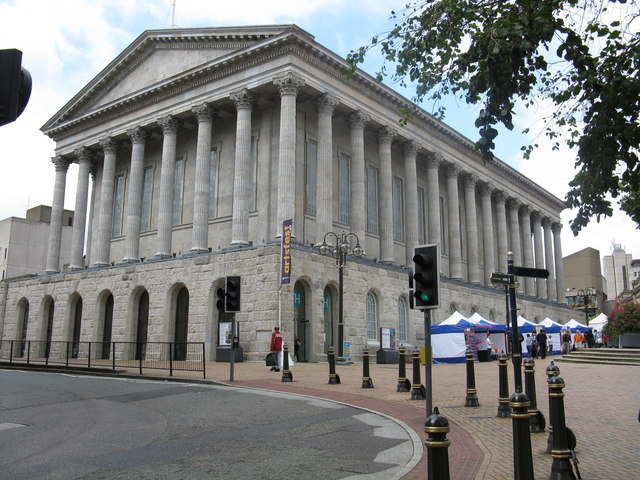 |
Birmingham Town Hall. Not a Greek Temple. The form of a building does not necessarily reflect its basic function. © Copyright Peter Whatley and licensed for reuse under this Creative Commons Licence. |
Types and names of fortifications
For details of the classification scheme used in this web site click here.
For information on some of the classification systems that are used for medieval fortifications click here.
Confidence and remains
For a more detailed comment on what the confidence and remains statements mean can be found click here.
Location of sites
For some more information on the location of medieval fortifications click here.
This includes comments of map references, county boundary changes and place name evidence.
Site reuse and change
High status sites like manorial centres gain a certain kudos of place and the site itself becomes significant. This often results in sites being reused, often repeatedly. The close association of many castles with parish churches may mean that some and possibly many mottes and ringworks may be highly modified and reused Saxon thegnal burh sites – as has been shown at several excavations, although such evidence is unlikely to be found except with highly destructive intense excavation of a sort rarely carried out. A number of square C13/C14 moated sites may actually be much reworked low mottes recut to the latest style. How many moated manor houses started out as minor timber castles may be impossible to ascertain but some have been identified as such. Jean le Patourel work on Yorkshire moated sites shows the close association between some moated sites and timber castles.
Social Class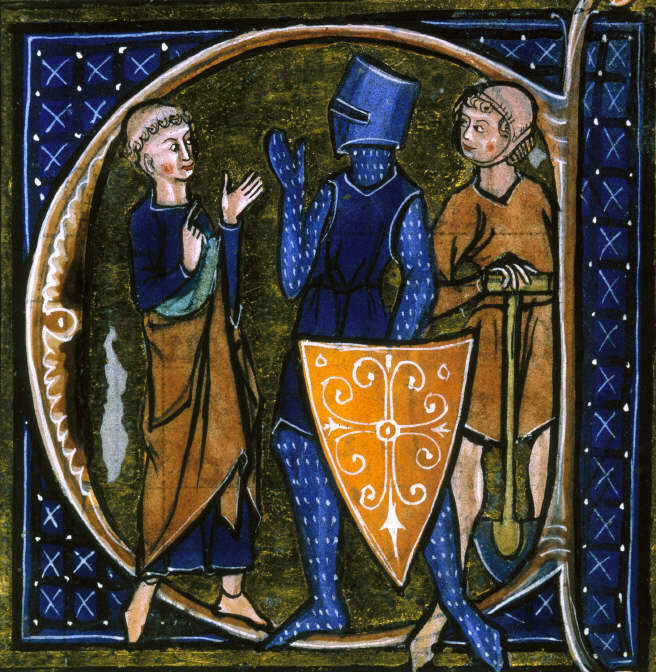
Medieval society was hierarchical. A base level society was supposedly dived into three main groups: those who fought; those who prayed and those who worked. In practice there was considerable overlap between the first two classes - the ruling elite, who derived their status from their, sometimes notionary, military duties, and churchmen. The people were often from the same small number of families. Fortified building were generally the exclusive residences of these first two classes, although towns people, in particular the wealthier merchants, could also build fortified house and communal defences such as town walls.
Within the 'military' class there were further subdivisions which can be of importance in regard to the form of fortified building used to express that status.
- Royal - The ruling monarch and heirs presumptive and apparent. The monarch had the ultimate responsibility for the defence of his/her realm and the was the ultimate source of legal and administrative authority. A considerable number of royal castles are, therefore, not actually used as residences of a monarch but were centres for the administration of royal authority and justice and for the collection of taxes. However, a number of actual royal residences were also castles and the royal palaces are recorded in Gatehouse.
- Baronial - A baron was a person called to attend the king in parliament by individual name. This could be a diverse group. Some barons were great landowners with considerable estates and hereditary peerage titles suck as Duke, Marquess, Earl and, latterly, Viscount and these are sometime differentiated from the other barons. The lesser barons, without title other than Lord, might be hereditary or might be men of talent called to parliament on only a few occasions with no hereditary element. There houses, which were also the centres for their estate management (which included some legal authority), would reflect their wealth and the source of their authority by being built in a fortified style as castles, great tower houses and such like.
- Gentry - Knights and squires who had, generally, a few (often just one) manorial landholding technical held by rent of military service. They were the class from which were drawn significant figures in the administrative and judicial system such as shire representatives at parliament, shire reeves, justices of the peace, royal commissioners etc. Their houses would reflect their wealth, which could vary considerably and which might include some military motifs such as crenelations, and in some areas, such as the Marches of Wales and Scotland, might be more seriously defensible.
Mounds of earth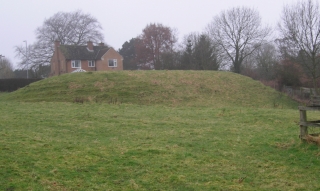
For a discussion on mounds of earth which may, or may not, be castles click
here.
Finding books etc.
Advice on finding books and other bibliographical sources can be found here.
Broken Links
Gatehouse contains thousands of links to other websites and online resources. All the links were viewed by me when originally added to the site or the databases from which many of the webpages on the site are constructed.As a personal project done by one individual, even with the help of many others, it is not possible to regularly check all these links - even with an automatic system - without taking up so much time that any other development of the site would entirely stop. Some individuals and organisation have seen the internet as a 'notice board' for putting up matter of limited and transitory importance and, therefore, will remove resources without apparent thought. Some organisation, notably county councils, appear to regularly change the design and urls of their websites and only rarely giving a forwarding link.
If you do come across a broken link please do inform Gatehouse. Some sites have been indexed by Internet Archive's Wayback Machine and entering a broken link url into the search box there may produce a version of the page (although images are often missing from the archived version of web pages). Alternatively paste http://web.archive.org/web/*/ into your browser before the url of the broken link.
Search
In the web site are over 6000 individual pages for medieval fortified sites and several hundred more individual pages identifying and detailing primary historical sources.
Unfortunately it is not possibly to directly search for an individual site from within the web site (but the county and site indexes are useful). The site is pretty well indexed by Google and the Google search box in the menu should produce results for most meaningful searches. However the latest information may not be indexed as Google updating of the changes to the site takes some time. Updates to the site are announced via an irregular newsletter.
I am not responsible for the advertisements on the Google results page and I gain no revenue from these.
For more complex searches, such as a list of the sites recorded by David Cathcart King in his seminal Castellarium Anglicanum, do download the databases on which this site is based and put them into a database management program or spreadsheet. Gatehouse is intended as a support tool to aid research so please feel free to use it this way.
Browser Compatibility
The latest version of Gatehouse (from November 2010) is designed to comply with the CSS3 standard. This means the site is best viewed in the latest versions of Firefox, Safari, Chrome or Opera. It should work in other browsers although features such as multicolumn text will not appear in Explorer or older versions of other browsers. Please do contact Gatehouse if you find browser incompatibility problems.
As yet no attempt has been made to make versions of the site specifically suited to smart phones or tablets. The designer of Gatehouse is trying to be an historian and is certainly not a web designer. It may be the content of Gatehouse is such that it can not be used effectively on the small screen of current 'smart phones'. I do welcome any advice on how to improve the functionality of Gatehouse across browsers and platforms.
Acknowledgements
This project has been much assisted by the help and support of many kind and
knowledgeable people.
My
thanks to those who have helped.
Disclaimer
While the author of Gatehouse has made every effort to ensure the accuracy of the data held within this web site and the associated downloadable databases, it must be appreciated that much of this is compiled from secondary sources and that the information supplied may not be a full or reliable statement of the archaeological resource. Gatehouse shall not be held liable in respect of any errors or omissions from the listing provided. If you use this site for something important you should check the cited sources and check the sources they have used. Please do inform Gatehouse of any errors you do find.
The site contains much copyright material belonging to third parties used
with permission on the bases that this site is not commercial and is provided
as an educational resource or under the general principle of 'fair use'. Use of material from this web site for commercial
purposes may breach copyright restrictions and result in prosecution. You will
need to check all given sources to establish the actual copyright holder.
Gatehouse will not assist in identifying copyright holders beyond the efforts already made in the online records.